The Greatest Danger is Hacked Perceptions
For years, I have monitored cyber threats for governments and international institutions. From securing diplomatic missions across 12 countries for the German Federal Foreign Office (Auswärtiges Amt) to tracking the digital footprints of terror financing for the Ministry of Interior in Türkiye, I have always encountered the same reality: The greatest danger I witnessed was not hacked devices, leaked databases, or cracked passwords. The greatest danger was hacked perceptions.
Today, when we say “Cyber Security,” we still picture hooded hackers and scrolling green code. But as a cyber intelligence professional who has operated in the field, I can tell you this: To collapse a state or an institution, you no longer need to attack their servers. You only need to target their reputation and the trust that holds their society together. From border security to election manipulation, I have operated wherever data is weaponized. And with this experience, I can tell you: Digital Disinformation is the nuclear weapon of the 21st century.
We Are in an Invisible War
Understanding Digital Disinformation
Wars used to be fought along physical borders. Now, they are fought on the screen of your smartphone, inside that “innocent” tweet you read with your morning coffee. I have personally analyzed how bot networks are coordinated during election periods, how terror organizations manipulate algorithms to spread propaganda, and how “Deepfake” content is designed to disrupt financial markets.
1. Who Pushes the Button? (The Geopolitics of Likes)
The biggest misconception is that disinformation is chaotic. It is not. It is a calculated investment with a specific ROI (Return on Investment). The “button” is almost always pushed by states and state-sponsored groups. But the motivation isn’t just to cause trouble; it is strictly transactional. In my experience, I have seen that foreign powers invest heavily in influencing elections based on their future interests.
The Actors and Ethical Complexity :
Two or three major companies, primarily based in Israel and India, operate at the center of this industry, focusing on election interference and disinformation prevention. I can attest that the products performing the best in this field are often of Israeli origin. Importantly, the necessity of producing counter-information to prevent disinformation inherently gives these software capabilities the potential for intentional or unintentional disinformation. This demonstrates the complex dual-use ethical framework of the industry.
2. The Death of the “Egg Account” (The Incubation Era)
If you are still trying to spot a bot by looking at its creation date or lack of a profile picture, you are fighting a modern war with a stone axe. Those days are over. Today, millions of accounts are created daily across the globe, but they don’t tweet immediately. They are put into “Incubation”. These sleeper accounts are kept dormant for months or years. When the time comes, they are sold to the highest bidder. Because they have a history, they bypass traditional security filters. The only reliable detection method left is analyzing the Synthetic Text Ratio. We are no longer looking for a “fake photo”; we are looking for the linguistic fingerprint of an LLM (Large Language Model) in their posts.
Field Evidence: Instant Data Correlation:
To quantify the access speed of these tools, we conducted a test: We created a new social media account using a freshly acquired, unlisted phone number (a ‘zero’ line from the state) and defined political views/interests. We searched this number in an undisclosed disinformation tool on the same day. The result was instantaneous: the tool successfully returned the profile. This demonstrates an incredible data ingestion speed, suggesting zero-latency correlation or direct data access, proving that high-value information is immediately accessible.
Operational Depth: Data Enrichment and Sociological Targeting :
Open-market social media analysis tools are useless in elections for this reason. Effective disinformation requires data enrichment. These software capabilities must be fed by external data sources, such as previously compromised Turkish Republic personal information databases. By adding layers like the user’s phone number, address, age, and gender, highly potent disinformation applications can be created. This process allows for the acquisition of the target audience’s sociological profile; for example, if the area of residence is economically depressed, disinformation focused on financial matters is the most effective tactic.
3. The Timeline of a Lie: Simultaneous Saturation
How does a lie wash over a nation in minutes? The process I have observed in the field is a masterclass in coordination. It is not a ripple; it is a tsunami. The attack happens simultaneously across three layers:
- The Swarm: Thousands of small, incubated accounts initiate the spark.
- The Merchants: “Blue Check” verified accounts, which have been bought and repurposed, validate the lie to trick the algorithms.
- The Amplifiers: If necessary, mainstream media channels are engaged through paid advertisements or compromised journalists.
The key here is location diversity. The attack is launched from different geographical locations at the exact same second to trick the platform’s “organic trend” algorithms.
The Mechanism of Validation :
- Seeding: The lie is planted in “news sites” that appear reliable but are actually front operations.
- The Echo Chamber: Bot networks and “useful idiots” (an intelligence term for those who unwittingly spread propaganda) are activated.
- Legitimation: The topic becomes a Trend Topic (TT), and mainstream media validates the lie with headlines like “Claims circulating on social media…”
4. The Future: We Need “Police AI”
The sheer volume of AI-generated disinformation has surpassed human capacity to moderate. We cannot fight machines with humans anymore. The future of digital security relies on “Police AIs.” We need advanced AI systems designed solely to audit the outputs of other LLMs. These systems must verify information with 100% accuracy against trusted data ledgers.
Establishing AI Provenance :
Given the proliferation of AI models in the market, it is paramount to establish the origin of any AI-generated content (text, image, etc.). For this to be operational, every AI model must be mandated to possess a unique, invisible metadata ‘fingerprint’ or identifier. While some large AI providers are already implementing such systems, all new AI models entering the public market must be obligated to report this unique identifier to public institutions and regulatory bodies. This standardization is necessary to ensure analysis and attribution can be performed swiftly and accurately by intelligence organizations.
In 2025 and beyond, the only thing that can stop a rogue AI manipulating a population is a stronger, ethically coded AI policing the digital borders.
INTELLIGENCE REPORT
TECHNICAL ANATOMY OF MODERN DISINFORMATION
Infrastructure, Data Enrichment, and Attribution Protocols (2025)
Classification: PUBLIC (Redacted for General Release) Author: Ozan Akyol | Digital Intelligence Sector: Cyber Warfare & Strategic Intelligence Date: November 2025
EXECUTIVE SUMMARY
Unlike traditional cyberattacks that prioritize stealth and anonymity, modern disinformation operations prioritize “Localization” and “Persistence.” This report outlines the technical architecture of state-sponsored and private-sector influence campaigns observed in the field.
1. INFRASTRUCTURE & NETWORK ARCHITECTURE
The primary objective of the network layer is not to hide the traffic, but to make it appear indistinguishable from organic local activity.
- 4G/5G SIM Farms (The Localization Layer): Botnets no longer rely solely on datacenter IPs, which are easily flagged. Instead, operators utilize industrial-scale 4G/5G SIM Farms.
- Operational Logic: The goal is to ensure traffic originates from a legitimate mobile carrier (e.g., a specific cell tower in Berlin or Istanbul). This bypasses “Datacenter IP” filters and mimics genuine user behavior.
- Weaponized IoT Devices: Compromised IoT devices (smart cameras, home routers) are utilized to achieve “Geo-Distribution.” By routing traffic through residential devices, the operation signals to platform algorithms that a topic is being discussed organically across the entire country, rather than a single server farm.
- Bulletproof Hosting Strategy: For the “Seeding” phase (hosting fake news sites), operators prefer Bulletproof Hosting providers located in jurisdictions with high resistance to international takedown requests, specifically USA, China, and Myanmar. The priority here is physical control and resilience against legal intervention.
2. C2 ARCHITECTURE & SOFTWARE STACK
The Command and Control (C2) infrastructure is designed for Portability and Speed, not aesthetics.
- Tech Stack: 80% of observed operations utilize a Python-based architecture. Django is the standard for User Interface (UI) development.
- Why Python? It allows for rapid prototyping (Hot-fixes), extensive library support for data manipulation, and easy Dockerization. If a server is burned, the entire C2 infrastructure can be migrated to a new jurisdiction in minutes.
- Minimalist Design: These tools do not have polished UIs. They feature raw dashboards focused on inputting targets and monitoring volume/sentiment.
3. DATA ENRICHMENT & TARGETING (The Kill Chain)
The most lethal aspect of modern disinformation is the fusion of social media data with leaked state databases.
- Database Management: Operators use SQL-based structures (PostgreSQL/MySQL) to handle massive datasets. Python libraries (Pandas/SQLAlchemy) are employed to ingest “Dump Data” (leaked ID numbers, addresses, GSM numbers) and convert them into operational targeting lists.
- The Confidence Algorithm: Systems use a “Confidence Score” to match a social media profile with a real-world identity:
- Match (Name + Surname + Phone): 70% Confidence
- Match (Name + Surname + Phone + Address): 90% Confidence
- Tactical Application: This score dictates the attack vector. High-confidence targets in economically depressed areas are targeted with financial disinformation; others may be targeted with political or social polarization content.
4. DETECTION & FORENSICS
Identifying these networks requires moving beyond simple content analysis to behavioral and visual forensics.
- Temporal Analysis: We analyze the timestamps of activity.
- Indicator: Does the account tweet every day at exactly 13:30? Is there a human-like randomization (jitter) in the intervals, or is it perfectly linear?
- Visual Forensics (GAN Detection): Profile pictures are scanned for artifacts typical of ThisPersonDoesNotExist (GAN-generated) faces, such as asymmetric pupils, background distortion, or ear irregularities.
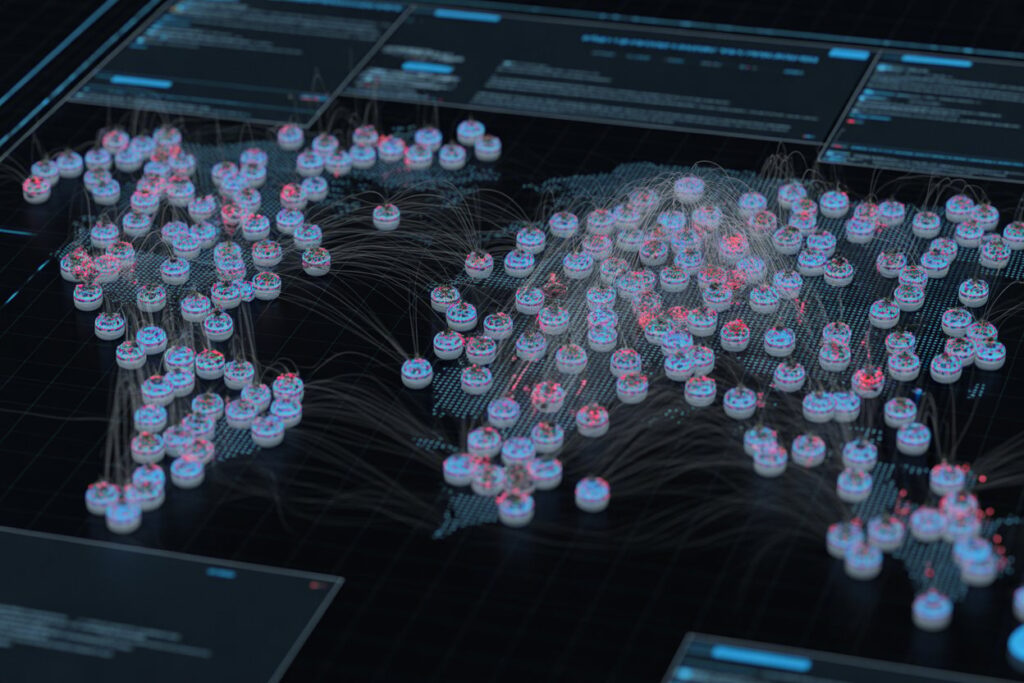
- Network Visualization (Maltego): While public institutions often use proprietary reporting tools, Maltego remains the industry standard for deep analysis. It is used to map the relationship clusters—visualizing who follows whom, who retweets whom, and funding sources.
Figure 1.1: Visualization of a coordinated botnet cluster targeting specific keywords. Node relationships indicate simultaneous Retweet/Quote actions, revealing the inorganic structure of the network. (Generated via Maltego).
5. ATTRIBUTION (Following the Trail)
In the cyber domain, IP addresses can lie, but money cannot.
- “Follow The Money”: Disinformation is expensive. It requires servers, thousands of SIM cards, software development, and ads.
- Attribution Methodology: Technical artifacts (e.g., comments in Russian/Chinese code) are often False Flags left intentionally to mislead. The most reliable attribution method is Cui Bono (Who Benefits?). Following the financial trail of server payments and spend similar to terror financing investigations often leads to the true perpetrator.
End of Report Access restricted to Operational and Strategic tier members.